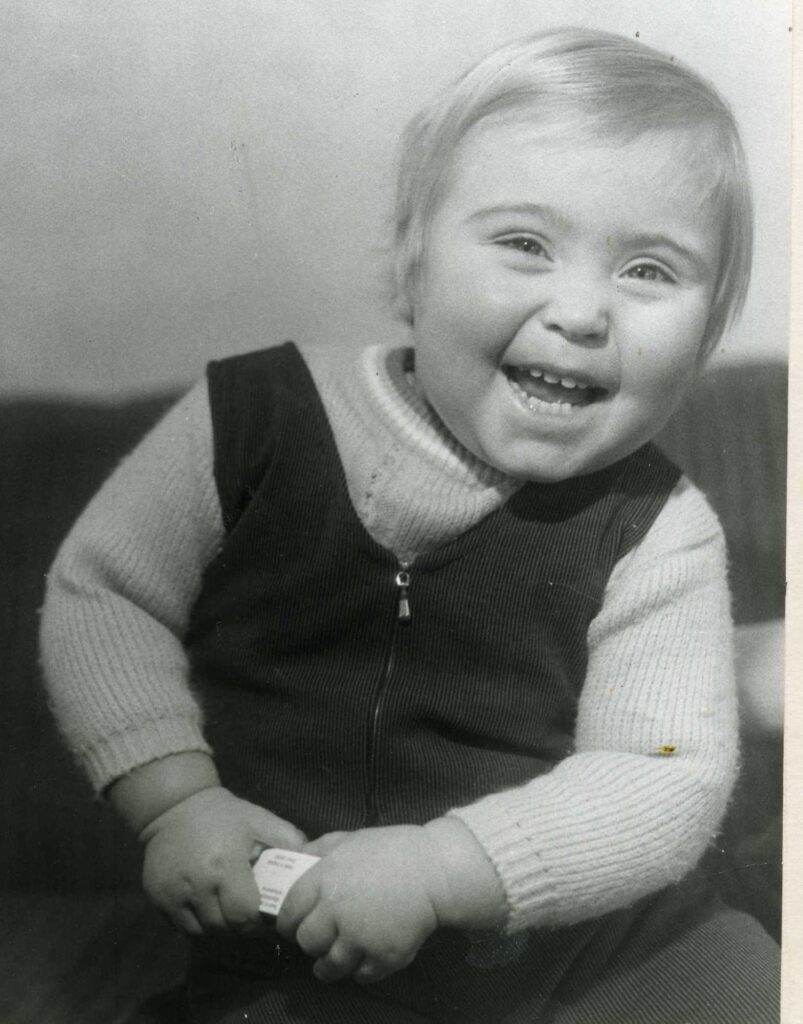
In the early seventies, our first child Danny was born. My wife Christine had a very difficult and protracted time delivering him and was sedated. Danny was presented to me in an incubator before being transferred to a specialist children’s hospital, as there was visible Spina Bifida and likely hydrocephalus. We were advised that, if we wished to christen him, we should do so before he was transferred to the specialist hospital.
Our life was fully planned up to that point, however we were suddenly thrown into a state of total confusion. We had no knowledge of spina bifida or hydrocephalus and neither of us had even heard of either condition. It was a very lonely time for a young, first-time dad, with no wife or child to hold.
Within 12 hours, Danny’s back was closed and, following frequent measuring, a shunt was inserted five weeks later. I was told this was the Spitz Holter shunt; a fairly new valve jointly developed by a paediatric surgeon and an American engineer with expertise in hydraulics. None of these was information I felt I needed to know. At six weeks, we were told we could take Danny home. We were very nervous and had many questions, one of which related to feeding. The ward sister assured us that Danny fed very well and was now on 65mls a day. Christine misheard mls as ‘meals’ and said she didn’t think she would be able to fit them all in.
The next five years were challenging. Knowledge came slowly, but it was generally left to us to find stuff out. Some things became clear very early on. First, Christine and I were going to be on our own with Danny outside of hospital visits. This was quite frightening for Christine as I was a London firefighter and would be away overnight on shifts. We also found out during our time with Consultants that they don’t all agree with each other and that medicine is a bit like the law. It can be left up to interpretation.
One particular Consultant, Mr. Duncan Forrest, stood out. Sadly, he is no longer with us but his papers and presentations on hydrocephalus can still be found online. Much of what he learned resulted from a three-year research paper put together by Leone Holgate (sponsored by the National Association of Spina Bifida and Hydrocephalus ASBAH).
This work identified a number of developmental issues that could be present in a child with hydrocephalus, to varying degrees. These included: spatial awareness, poor coordination, communication difficulties, balance issues and sequencing. Naturally, as Danny developed, we watched for signs that he might struggle in any of these areas.
I developed the view, quite early on, that a child with serious issues needs to be monitored by a team. I also firmly believed that the parents should be prominent members of that team. Not only do they monitor their child 24/7 but they have one thing a clinician does not have: a parent’s instinct. Very often, a parent or a grandparent will know something is wrong before a doctor is able to diagnose it. Mr. Forrest also believed this and, whenever he treated a child, he always looked at the wider picture and included the opinions of parents. In one of his papers, he wrote that he disagreed with some of his respected colleagues who would delay corrective surgery for some weeks while development potential could be assessed more fully. The thinking being that was, if the potential was low, the surgery could be an irrelevance. Mr. Forrest argued that surgery should come first and this would give the child a greater chance to develop their potential.
During my time as Chairman of the Essex branch of the Association of Spina Bifida and Hydrocephalus (more on this in another blog) I had cause to ask Mr. Forrest to meet with some parents who had concerns with their Consultant’s approach. He agreed to these meetings; a stance for which both he and I were criticised. I do not apologise as I believe it to be the right of any worried parent to seek a second opinion. Thankfully, I think this is now an accepted position.